
Ascend Technologies vs. In-House IT: Which Fits Your Orlando-Area Business?
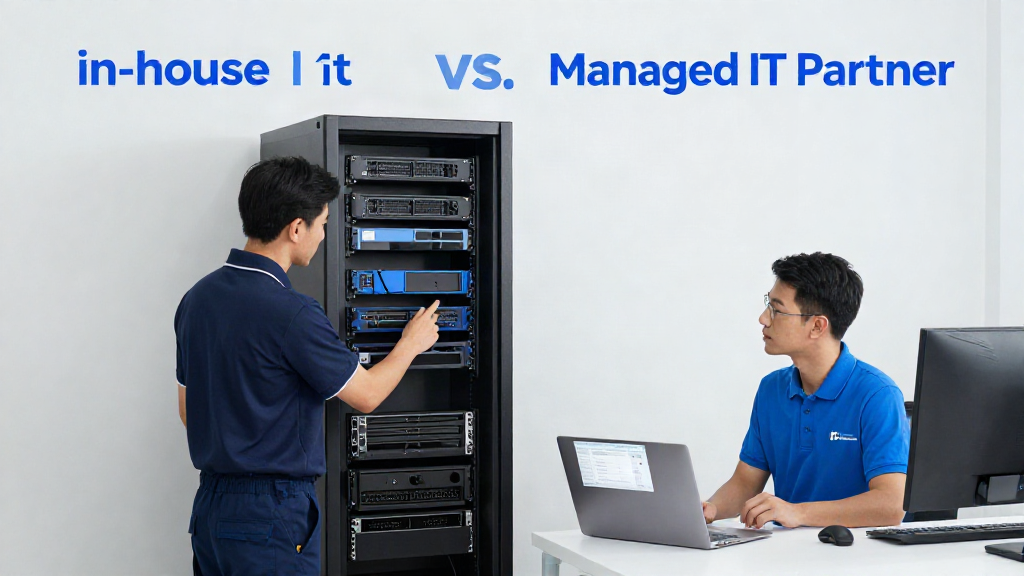
If you run a business with 10 to 200 employees around Orlando, Tampa Bay, Lakeland, Winter Haven, or Kissimmee, you have probably weighed the same question: do we hire our own IT person, or do we hand it to a local partner?
Neither answer is automatically right. The honest answer is that in-house IT and a managed IT partner solve different problems, and the fit depends on your size, your growth plans, and how much risk you can carry when something breaks at 4 p.m. on a Friday.
This is a straight comparison, not a sales pitch. Here is when building an internal IT function makes sense, when partnering with Ascend Technologies makes sense, and how to tell the difference for your business.
What In-House IT Actually Buys You
A dedicated IT hire is a real asset. You get someone who knows your people by name, walks the floor, and can put hands on a machine within minutes. For a business with a heavy on-site footprint, a single-location operation, or specialized line-of-business software that needs constant attention, that presence has value.
Here is what it costs you, in ways that rarely show up on the offer letter:
- Salary and benefits. A mid-level IT administrator in the Central Florida market typically runs $65,000 to $95,000 fully loaded, before training, certifications, or a raise cycle.
- Coverage gaps. One person means one point of failure. Vacation, illness, and turnover all become downtime events — and the average IT vacancy takes weeks to fill.
- Breadth limits. No single hire covers networking, cybersecurity, Microsoft 365, VoIP, backup, and compliance equally well. Most are strong in two or three and learning the rest on your dime.
- Tools are still your bill. Monitoring, endpoint security, backup, and patching platforms are separate line items whether or not you have staff.
In-house IT is a good fit when your environment is stable, your risk is low, and you can genuinely afford to be offline for a day or two if your one person is out.
What a Managed IT Partner Actually Buys You
An MSP is not "IT as a vendor." Done well, it is an entire department on a flat monthly rate — monitoring, patching, help desk, security, cloud, and planning — shared across a team so there is always someone on duty.
That is the model Ascend Technologies runs on. Proactive monitoring and patching so problems get handled before they reach your staff. A help desk that answers when you call. Cloud services, Office 365, VoIP, and security cameras under one roof. Layered security that assumes somebody will try to get in, because sooner or later somebody will.
For a 10-to-200-employee business, this is usually the difference between hoping nothing breaks and knowing what happens when it does.
The Comparison, Side by Side
Cost. In-house means one salary, plus tools, plus training, plus the cost of a bad hire. Managed IT means one predictable monthly invoice, and you can scale it up or down as headcount changes. If your IT bill is currently a mystery every month, flat-rate pricing alone is worth the conversation.
Coverage. In-house coverage is business hours plus goodwill. Managed coverage is a team, which means vacation weeks and busy stretches are covered by design rather than by heroics.
Security. Threats aimed at small and mid-sized businesses do not pause because you have one IT person. Layered security — endpoint protection, email filtering, patching discipline, backup and recovery — is a full-time discipline. Under a managed model, it is somebody's actual job, every day.
Accountability. This is the one owners feel most. Building in-house still leaves you managing internet, phones, software vendors, and hardware warranties. With a single MSP, there is one number to call and one team that owns the outcome — no finger-pointing between vendors while your team sits idle.
Recovery time. Ask anyone who has had a server go down without a backup plan. The goal is not "never have a problem." It is recovering in hours, not days.
Strategic planning. An in-house generalist is usually buried in tickets. A managed partner is supposed to keep the tickets from piling up, which frees them to plan your next 12 months of budget, hardware lifecycle, and risk instead of just surviving this week.
A Hybrid Answer Worth Considering
For the largest businesses in the 150-to-200-employee range, the practical answer is often both: a lean internal resource who owns internal relationships and line-of-business software, backed by a managed partner for infrastructure and security. You get the on-site presence and the depth.
That model is also a good way to de-risk a first hire. You keep IT running while you recruit, rather than hiring in a panic.
Questions to Ask Yourself Before You Decide
- How long can we actually be down before it costs real money? If the answer is "hours," you need team coverage, not one person.
- Who is covering us the week our IT person takes vacation?
- Do we have someone whose daily job is cybersecurity, or is that a side task?
- Can we afford the recruiting risk of a single hire who may leave in a year?
- Is our IT spend predictable enough to budget, or does it surprise us every quarter?
If you answered those and felt uneasy, that is the signal. Not every business needs an MSP, but most overlooked ones need better coverage than a single person can honestly provide.
Where Ascend Technologies Fits
Ascend Technologies is built for Central Florida businesses that want a local, Central FL based IT partner without enterprise pricing. That means proactive managed IT, layered security, flat-rate predictability, and one accountable team across the Orlando, Tampa Bay, Lakeland, Winter Haven, and Kissimmee corridors.
We are not going to tell you in-house IT is wrong. If you have a stable environment and a great technician, keep them — and consider what happens the week they are gone.
If you are tired of downtime, unpredictable bills, slow tickets, and vendors pointing at each other while your team waits, that is exactly the gap a managed IT partnership closes.
The Bottom Line
In-house IT is a person. A managed IT partner is a department. Choose based on the risk you can carry, not the invoice you like best this month.
If you are weighing the two, start with a conversation, not a contract. Ask what proactive coverage would actually look like in your environment, what it costs on a flat rate, and what happens on the day something goes wrong. Straight answers to those three questions will tell you which model fits your business.